
Why Global Pharma Companies Source Buclizine HCl from India Table of Contents If you have ever managed API procurement for a
Why Global Pharma Companies Source Buclizine HCl from India
- Home
- Why Global Pharma Companies Source Buclizine HCl from India
Blog
 By Team DK Pharmachem
April 14, 2026
By Team DK Pharmachem
April 14, 2026
Why Global Pharma Companies Source Buclizine HCl from India
By Team DK Pharmachem
April 14, 2026
Why Global Pharma Companies Source Buclizine HCl from India
Table of Contents
If you have ever managed API procurement for a mid-sized pharmaceutical company, you know the headache that comes with finding a supplier who ticks every box at once: pharmacopoeial purity, consistent batch-to-batch quality, a price point that doesn’t wreck your margins, and a logistics track record that won’t leave your production line idle. Buclizine Hydrochloride is not exactly a blockbuster molecule – it doesn’t get the attention that antibiotics or oncology APIs do – but for the companies that need it, sourcing it reliably is surprisingly non-trivial.
Over the past two decades, India has quietly become the default sourcing destination for Buclizine HCl for procurement teams across Europe, Southeast Asia, Latin America, and Africa. This isn’t marketing – it’s a pattern visible in trade data, regulatory filings, and the frank conversations that happen at CPhI and AIOCD meetings. This blog breaks down the real reasons behind that shift, what it means for your supply chain, and what you should actually be asking before you sign a supply agreement.
What exactly is Buclizine Hydrochloride and Why does it matter?
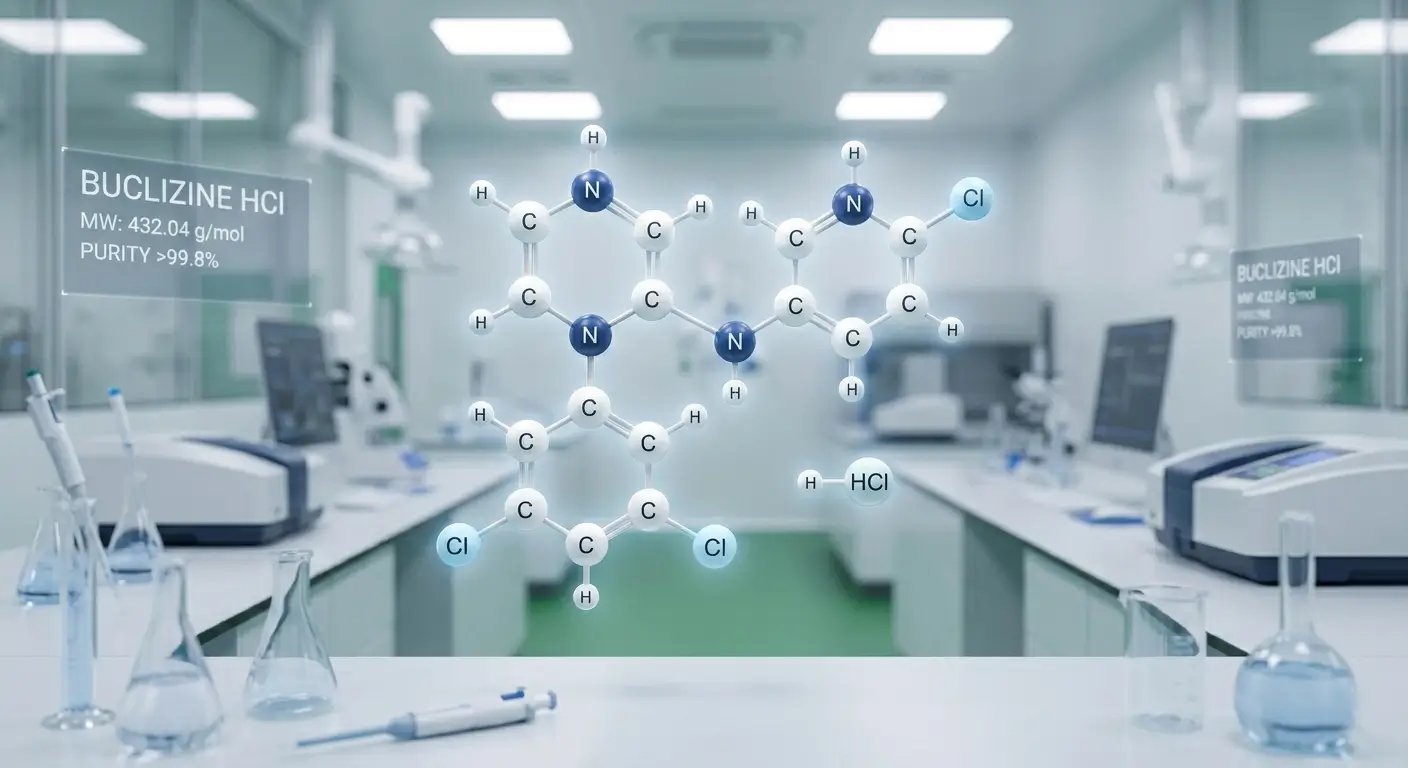
Buclizine Hydrochloride (CAS No. 129-74-8) is a first-generation piperazine antihistamine. Its molecular formula is C₂₈H₃₃ClN₂·HCl and it has a molecular weight of approximately 505.54 g/mol. Chemically, it belongs to the diphenylmethylpiperazine class – the same broad family as cinnarizine and cyclizine.
Importance of Quality in API Manufacturing
Unlike many antihistamines developed around the same era, Buclizine HCl has stayed clinically relevant because it does several things at once. Its primary approved indications include:
- Appetite stimulation – particularly in underweight children, patients recovering from illness, or those experiencing anorexia secondary to chronic disease. This remains its most commercially important use in South and Southeast Asia.
- Motion sickness prevention – it acts centrally on the vomiting center and the vestibular system, making it effective for nausea and vertigo associated with travel.
- Antiemetic use – it is prescribed in combination with vitamins and nutritional supplements to manage nausea in various clinical settings.
In markets like India, Bangladesh, Nigeria, and the Philippines, Buclizine HCl is a high-volume API. Combination tablets – typically pairing Buclizine with Vitamin B-complex, Lysine, or both – are among the highest-selling OTC pediatric preparations. This sustained regional demand is precisely what has shaped the manufacturing ecosystem in India.
Key Physical and Chemical Properties
- Appearance: White to off-white crystalline powder
- Solubility: Slightly soluble in water; soluble in ethanol and chloroform
- Melting point: 215–220°C
- Storage: Store in a cool, dry place, protected from light and moisture
The Real Story Behind India’s API Dominance
The narrative you often see – “India is cheap” – is incomplete and, frankly, a bit insulting to the technical sophistication of Indian API manufacturers. Yes, cost is a factor, but procurement professionals who have actually toured Indian facilities and compared them to alternatives in China or Eastern Europe will tell you that cost alone does not explain the loyalty.
1. Regulatory Infrastructure That Actually Holds Up
India has more US FDA-approved pharmaceutical manufacturing plants outside the United States than any other country. That’s not a small detail. It means that when an Indian API supplier tells you their facility is GMP-compliant, there’s a real regulatory framework behind that claim – not just a self-certification.
For Buclizine HCl specifically, reputable Indian manufacturers maintain compliance with WHO-GMP, EU-GMP (EMA), and often USFDA standards. This is critical because your downstream regulatory submissions depend on the DMF (Drug Master File) or CEP (Certificate of Suitability) that your API supplier can provide. An Indian supplier with a strong DMF track record can meaningfully shorten your own NDA or ANDA timelines.
2. Decades of Synthesis-Level Expertise
Buclizine HCl synthesis is not trivial. The commercial route typically involves a multi-step process starting from p-chlorobenzhydryl chloride and 1-(p-tert-butylbenzyl)piperazine, with careful control over intermediate purity, reaction temperature, and purification steps to arrive at the final hydrochloride salt with acceptable impurity profiles.
Indian API manufacturers – particularly those in the pharmaceutical clusters of Hyderabad, Ahmedabad, and Ankleshwar – have been making this molecule (and closely related piperazine antihistamines) for thirty-plus years. That institutional chemistry knowledge translates to more consistent impurity control, better yields, and fewer batch failures than you will typically encounter from newer entrants.
3. Supply Chain Resilience and Scale
The COVID-19 pandemic stress-tested global pharmaceutical supply chains hard. Companies that had sole-sourced from China for API supply found themselves scrambling. India’s Buclizine HCl manufacturers generally fared better through that period because they had diversified their own raw material sourcing and had domestic chemical supply chains to fall back on.
India is also well-positioned for scale. Whether you need 50 kg for a clinical batch or 5 metric tons for commercial supply, established Indian API manufacturers can accommodate. Many have dedicated bulk API reactors and can offer flexibility on lot sizing that smaller European producers simply cannot match economically.
4. Cost Structure That Goes Beyond Labour
Yes, labour costs in India are lower than in Western Europe or North America. But that’s only one component. The cost advantage in Indian API manufacturing also comes from integrated chemical supply chains, government incentives under schemes like the Production Linked Incentive (PLI) for pharmaceuticals, efficient multi-product plant architectures, and decades of process optimization.
For a commodity-adjacent molecule like Buclizine HCl, this translates to meaningful savings – often 30-50% lower API cost compared to equivalent-quality European manufacturing, without sacrificing the quality attributes you need to pass your own finished product specifications.
Quality standards for selecting Buclizine Hydrochloride Supplier: What to actually look for
Not all Indian Buclizine HCl suppliers are the same. The Indian API industry spans everything from USFDA-inspected, globally integrated operations to small regional manufacturers whose quality systems are much thinner. Here is what a serious qualification process should cover:
Pharmacopoeial Specification Alignment
Buclizine HCl is listed in the British Pharmacopoeia (BP). If your finished product targets regulated markets, your supplier must meet BP specifications as a minimum — this includes tests for appearance, solubility, identification (IR, melting point), related substances (impurity limits by HPLC), loss on drying, sulphated ash, and assay (NLT 99.0%, NMT 101.0% on the dried basis).
For markets where BP is not the reference standard, ensure the supplier can provide COAs (Certificates of Analysis) aligned to your own in-house specifications and that their method validations are documented and accessible.
Impurity Profile and Related Substances
This is where supplier quality truly diverges. Buclizine HCl can carry process-related impurities from incomplete reactions or inadequate purification – key ones to ask about include the des-chloro analog, the N-oxide impurity, and residual solvents from the synthesis workup. Ask specifically for the supplier’s impurity profile data across multiple production batches, not just a single COA.
Stability Data
Buclizine HCl is relatively stable under recommended storage conditions, but you should ask for accelerated stability data (40°C/75% RH, 6 months) as a minimum, and preferably long-term data at 25°C/60% RH if you are targeting a 24-36 month shelf life for your formulation. Suppliers who cannot provide this are operating below the quality standard you should accept.
Audit Readiness
Any serious supplier should welcome an audit – either a physical site visit or a remote desktop audit using a structured questionnaire. Be cautious of suppliers who are evasive about site visits or who cannot produce batch manufacturing records, process validation reports, change control documentation, or deviation and CAPA logs on request.
Navigating the Regulatory Landscape for Buclizine HCl Import
Importing pharmaceutical APIs across borders involves a regulatory layer that many procurement teams underestimate until it delays a product launch. Here is a practical overview of what’s typically involved when sourcing Buclizine HCl from India:
- Drug Master File (DMF): Your Indian supplier should have an active, updated DMF filed with the relevant regulatory body in your target market (USFDA, EMA, etc.). Cross-reference the DMF number before signing any supply agreement.
- Certificate of Suitability (CEP): For European markets, a CEP issued by EDQM is the gold standard. Not all Indian suppliers hold a CEP for Buclizine HCl — if this matters to your dossier, verify upfront.
- Import licenses and narcotic/precursor declarations: Buclizine HCl is not a controlled substance, but some countries have API import notification requirements. Confirm with your regulatory team which import authorizations are needed in your market.
- Country of origin documentation: India-sourced APIs typically benefit from preferential trade arrangements under various bilateral and multilateral agreements. Ensure the supplier can issue correct country of origin certificates for customs clearance.
Practical Tips: Getting the Sourcing Decision Right
Based on what experienced API procurement professionals consistently flag, here are the practical things that separate a good Buclizine HCl sourcing decision from a costly one:
Don’t sole-source
Even if you find an excellent primary supplier, qualify at least one secondary source. API manufacturing plants face shutdowns – for regulatory remediation, natural disasters, maintenance, or capacity constraints. Having a backup that is already qualified means a supply disruption doesn’t automatically become a production crisis.
Negotiate on more than price
Lead times, minimum order quantities, release testing timelines, and supply commitments during peak demand periods matter as much as the unit price. A supplier offering a lower price but 16-week lead times with inflexible MOQs may cost you more overall than one priced slightly higher with reliable 8-week supply and smaller lot flexibility.
Request reference customers
A credible supplier should be able to connect you with existing customers willing to provide a reference. If a supplier declines this, treat it as a yellow flag.
Visit before you commit
Remote qualification has improved significantly since the pandemic, but for a supplier you expect to form a long-term relationship with, an in-person site visit is still the gold standard. Indian manufacturers that genuinely meet international GMP expectations will not hesitate to host you.
Market Demand Trends for Buclizine Hydrochloride
Global demand for Buclizine HCl has been quietly growing, driven by a few converging trends:
- Rising pediatric nutrition focus in developing markets: In South Asia and Sub-Saharan Africa, pediatric appetite stimulants (many containing Buclizine HCl) are among the fastest-growing OTC categories. Urbanization, rising incomes, and greater health awareness are all driving volume.
- Travel medicine growth: Post-pandemic, international travel has rebounded strongly and with it, demand for motion sickness prevention products. Buclizine HCl remains a frontline option in several established markets.
- Reformulation opportunities: Some pharmaceutical companies are revisiting older antihistamine APIs for novel combination formulations, line extensions, or generic entries in markets where patent protections on newer agents have lapsed. Buclizine HCl’s established safety and efficacy profile makes it a low-risk API choice for such projects
Conclusion
India’s position as the preferred source for Buclizine HCl is the result of decades of manufacturing investment, regulatory discipline, and accumulated chemistry expertise – not just a labour cost arbitrage. For pharmaceutical companies evaluating their API supply strategy, India offers a compelling combination of quality, scale, cost, and regulatory acceptance that is genuinely difficult to replicate from other geographies.
That said, “India” is not a monolith. The difference between a well-qualified, audit-ready Indian API manufacturer and one that is not can be the difference between a smooth regulatory filing and a 12-month delay. The sourcing decision deserves more rigour than simply picking the lowest quote from a trade directory.
If you are evaluating Buclizine HCl sources and would like to discuss technical specifications, regulatory documentation, or supply capacity in more detail, reaching out to established Indian API manufacturers with verifiable GMP credentials and a proven export track record is your best starting point.
Related posts:
- How to Choose the Right API Supplier for Pharmaceutical Manufacturing
- Choosing the Right Trimethobenzamide Hydrochloride API Manufacturer in India
- Propofol API Manufacturing Process: Quality Standards and WHO-GMP Compliance
- Buclizine Hydrochloride API Manufacturing Process: Quality & WHO-GMP Standards
- Itopride Hydrochloride API: Purity, Stability & Pharmacopoeial Specifications
- How US Generic Drug Makers Can Qualify Indian API Manufacturers: A Pharma Sourcing Checklist
- Choosing the Right Mesalamine Manufacturer: WHO-GMP, DMF & COA Checklist
- How In-House Analytical Validations Reduce Supply Chain Risks in Contract Manufacturing
- What Actually Drives API Pricing in the Pharmaceutical Industry: Raw Materials, Regulatory Load, or Freight?
- Fenofibrate API: Specifications, Grades, and Global Export Requirements