
How In-House Analytical Validations Reduce Supply Chain Risks in Contract Manufacturing Table of Contents In contract
How In-House Analytical Validations Reduce Supply Chain Risks in Contract Manufacturing
- Home
- How In-House Analytical Validations Reduce Supply Chain Risks in Contract Manufacturing
Uncategorized
 By Team DK Pharmachem
September 09, 2026
By Team DK Pharmachem
September 09, 2026

How In-House Analytical Validations Reduce Supply Chain Risks in Contract Manufacturing
By Team DK Pharmachem
September 09, 2026
How In-House Analytical Validations Reduce Supply Chain Risks in Contract Manufacturing
Table of Contents
In contract manufacturing, supply chain risks can come from more than raw material shortages or production delays. Testing and quality activities can also affect timelines when important analytical work depends on external laboratories.
For pharmaceutical manufacturers, having analytical capabilities in-house can provide better control over testing, validation, investigations and stability studies. This becomes especially important when an API or pharmaceutical intermediate moves from development to commercial manufacturing.
The U.S. FDA reported that 42% of new drug shortages during 2022–2024 were associated with quality issues or manufacturing delays. This highlights why quality and manufacturing controls are closely linked to supply continuity.
For contract manufacturers, analytical capability is therefore not just a laboratory function. It can also help reduce avoidable supply-chain risks.
Why Analytical Dependencies Can Create Supply Chain Risk
A contract manufacturing process involves several connected steps: production, sampling, testing, quality review, release and shipment.
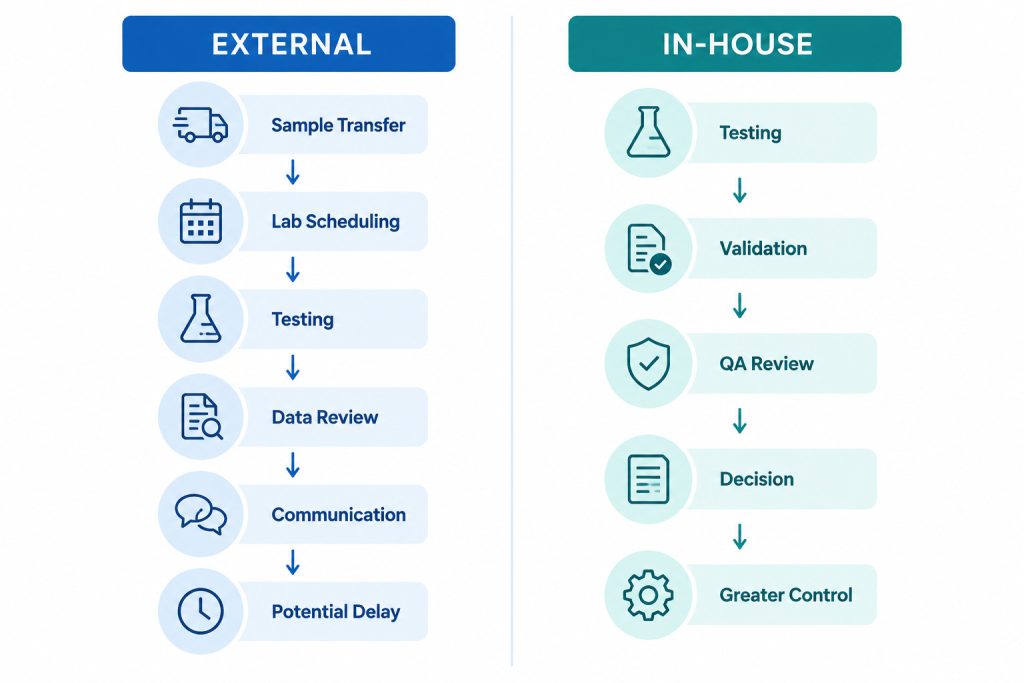
When analytical work is outsourced, another dependency is added to this process. Samples may need to be transferred to an external laboratory, testing schedules need to be coordinated and reports may need to be reviewed and clarified.
Each additional handoff can create another point where a project may slow down.
External laboratories can be valuable for specialised testing. However, having critical analytical activities available internally can reduce unnecessary dependencies and give manufacturers greater control over their timelines.
What Is Analytical Method Validation?
Analytical method validation confirms that a testing method is suitable for its intended purpose.
According to ICH Q2(R2), validation can involve characteristics such as accuracy, precision, specificity, detection limit, quantitation limit, linearity and range, depending on the analytical procedure.
In simple terms, validation helps establish that a laboratory method can reliably measure the quality attributes it is intended to measure.
For contract manufacturers, this is important because analytical results support decisions about product quality, investigations and batch release.
When method development, validation and testing are handled within the same laboratory environment, QC, QA and manufacturing teams can work with connected information and respond more easily when additional testing or clarification is required.
How In-House Validation Can Reduce Delays
The main benefit of in-house analytical validation is greater control over the testing process.
When validation is handled externally, manufacturers may need to coordinate:
- • Sample transfers
- • Laboratory availability
- •Technical information
- • Validation protocols
- • Reports and data review
- • Additional testing
Keeping these activities in-house can reduce some of these external handoffs.
This can be particularly useful when a project requires:
- • New analytical method validation
- • Method revalidation after a change
- • Additional testing during development
- • Investigation of unexpected results
- • Analytical support for process validation
- • Data required for quality review
Instead of managing each activity through a separate external party, the relevant technical and quality teams can work within the same system.
This does not guarantee faster timelines, but it can provide better visibility, coordination and control over activities that influence manufacturing schedules.
Analytical Validation vs Process Validation
Analytical validation and process validation are different, but both support manufacturing quality.
Analytical validation confirms that a testing method is suitable for its intended purpose.
Process validation provides documented evidence that a manufacturing process can consistently operate within established parameters and produce material that meets predetermined quality requirements. FDA guidance describes process validation as a lifecycle approach covering process design, qualification and continued process verification.
Having both capabilities within an integrated quality environment can make it easier for QC, QA and manufacturing teams to work together when process changes or investigations require additional analytical data.
Why Stability Studies Matter
Stability studies show how the quality of a drug substance or product changes over time under defined conditions.
They can support decisions related to storage conditions, retest periods and shelf life.
For contract manufacturers, stability testing can become another source of dependency if it is completely outsourced.
In-house short- and long-term stability studies allow testing, documentation and quality review to remain within the manufacturer’s established systems.
This can be particularly useful when additional time points, testing or investigations are required.
Building Analytical Capability Around Quality
In-house testing is most useful when it is supported by a strong quality system.
At D.K. Pharmachem, Good Laboratory Practice (GLP) is an integral part of the Quality Management System. Its QC laboratory is equipped with IR, GC, HPLC, UV and Karl Fischer systems for analytical testing.
D.K. Pharmachem also conducts analytical method validations, process validations and short- and long-term stability studies in-house, with Quality Assurance oversight.
Keeping these activities within the same quality environment helps connect laboratory testing with QA and manufacturing activities, supporting consistency, traceability and better coordination.
D.K. Pharmachem is also ISO 9001:2015 certified and 21 CFR Part 11 compliant, supporting controlled quality processes and electronic records where applicable.
What This Means for Contract Manufacturing Customers
For a pharmaceutical company choosing a contract manufacturing partner, in-house analytical capability can offer an additional layer of operational control.
A manufacturer with internal testing, validation and stability capabilities may be better positioned to:
- • Reduce external laboratory dependencies
- • Coordinate QC, QA and production more closely
- • Investigate unexpected results efficiently
- • Maintain continuity of analytical data
- • Support process and product changes
- • Manage stability programs within its own systems
The goal is not to eliminate every supply-chain risk. Instead, it is to reduce avoidable dependencies that can affect quality decisions and manufacturing timelines.
What Should Companies Ask a Contract Manufacturer?
Before selecting a contract manufacturing partner, procurement, QA and technical teams should understand what analytical work the manufacturer can manage internally.
Some useful questions include:
- • Are analytical methods validated in-house?
- • Are process validations conducted internally?
- • Are short- and long-term stability studies performed in-house?
- • What analytical instruments are available?
- • How does QA oversee laboratory activities?
- • How are analytical data and electronic records controlled?
- • How are deviations and investigations managed?
- • What analytical support is available during commercial manufacturing?
These questions can help companies understand how much control a potential partner has over critical quality activities
Frequently Asked Questions
Does in-house analytical validation eliminate supply chain risk?
No. It cannot eliminate supply-chain risk completely. However, it can reduce certain dependencies on external laboratories, including sample transfers, scheduling and technical coordination.
What is the difference between analytical and process validation?
Analytical validation confirms that a testing method is suitable for its intended purpose. Process validation confirms that a manufacturing process can consistently produce material that meets defined quality requirements.
Why are HPLC and GC important in pharmaceutical quality control?
HPLC and GC are widely used analytical techniques. Depending on the validated method, they can support testing for parameters such as assay, purity and impurities.
Why are stability studies important in contract manufacturing?
They provide evidence of how material quality changes over time under defined conditions and support decisions around storage, retesting and shelf life.
How does QA support in-house validation?
QA oversees validation, testing and documentation activities to ensure they follow established procedures and quality requirements, supporting consistency and traceability.
What should companies ask about a CMO’s analytical capabilities?
Companies should ask what testing and validation activities are performed internally, what equipment is available, how QA oversees the laboratory and how analytical data is controlled.
Conclusion
In contract manufacturing, supply-chain resilience starts before a product is released or shipped. Analytical capabilities can influence how efficiently a manufacturer validates methods, investigates quality issues and generates stability data.
By keeping analytical method validation, process validation and stability studies in-house, supported by appropriate equipment and QA oversight, manufacturers can maintain greater control over critical quality activities.
For pharmaceutical companies evaluating a contract manufacturing partner, the question should therefore go beyond:
“Can they manufacture our product?”
It should also be:
“How much of the analytical and quality process can they control themselves?”
That level of control can be an important factor in building a more predictable and resilient contract manufacturing supply chain.
Disclaimer: The information provided on this page is for general informational purposes only and does not constitute pharmaceutical, regulatory, technical or quality assurance advice. Specific validation, stability and manufacturing requirements may vary according to the product, process and applicable regulatory requirements. Please contact D.K. Pharmachem directly for product-specific information and business enquiries. © 2026 D.K. Pharmachem. All rights reserved.
Related posts:
- Propofol API Manufacturing Process: Quality Standards and WHO-GMP Compliance
- Buclizine Hydrochloride API Manufacturing Process: Quality & WHO-GMP Standards
- Choosing the Right Trimethobenzamide Hydrochloride API Manufacturer in India
- How to Choose the Right API Supplier for Pharmaceutical Manufacturing
- Choosing the Right Mesalamine Manufacturer: WHO-GMP, DMF & COA Checklist
- Itopride Hydrochloride API: Purity, Stability & Pharmacopoeial Specifications
- Choosing the Right Itopride Hydrochloride Manufacturer, Supplier & Exporter in India
- Why Global Pharma Companies Source Buclizine HCl from India
- How US Generic Drug Makers Can Qualify Indian API Manufacturers: A Pharma Sourcing Checklist
- Choosing the Right Hydralazine Hydrochloride Manufacturer, Supplier & Exporter in India