Introduction

When sourcing Propofol API, pharmaceutical manufacturers need to look beyond a single purity figure. They also need to understand how impurities are controlled, how the material is tested and whether the supplier can provide the documentation needed for quality and regulatory review.
Propofol is an active pharmaceutical ingredient used in injectable medicines for general anaesthesia and sedation. Its chemical name is 2,6-diisopropylphenol. Because it is used in a parenteral formulation, the quality of the API and the evidence supporting its specifications are important considerations for manufacturers.
This is where Good Manufacturing Practices (GMP), good laboratory practices and appropriate analytical testing become important.
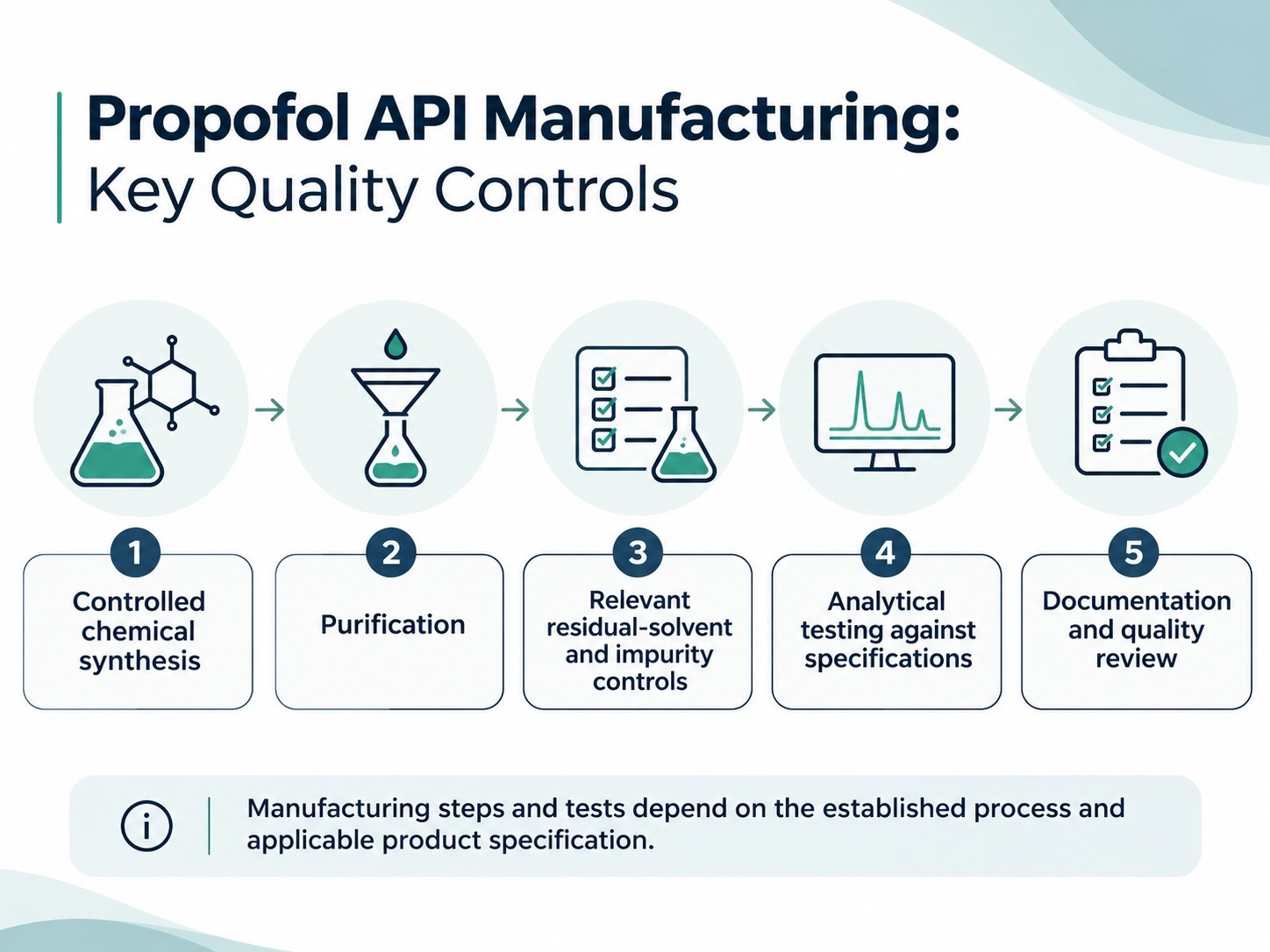
Manufacturing Propofol API involves controlled chemical synthesis, purification and testing. Each stage must be managed so that the resulting material meets its established quality requirements.
For API buyers, understanding these stages helps make supplier evaluation more informed and product-specific.
What Makes Propofol API Manufacturing Complex?
The challenge is not simply producing the intended compound. A manufacturer must also control relevant impurities, demonstrate that the material meets its specification and maintain records that support quality decisions.
Key considerations include:
- • Chemical identity: Confirming that the material is Propofol.
- • Assay and purity: Establishing the amount of the intended compound against the applicable specification.
- • Impurity control: Assessing relevant related substances and other impurities against defined limits.
- • Residual solvents: Controlling solvents that may remain from synthesis or purification.
- • Handling and packaging: Maintaining the material’s quality under appropriate conditions.
- • Deviation management: Unexpected events are investigated and addressed through appropriate corrective and preventive actions.
- • Documentation: Keeping records of testing, batch review and quality decisions.
These requirements are connected. A high assay result alone does not prove that every impurity is within its required limit or that the full product specification has been met.
Key Stages in Propofol API Manufacturing
The exact process depends on the manufacturer’s established route. The following overview explains the main stages and their quality considerations without assuming that every manufacturer uses an identical process.
1. Chemical Synthesis
Synthesis is the stage in which the intended chemical compound is produced through a controlled reaction process.
DK Pharma’s published Propofol product page describes an alkylation-based synthesis route. The specific reaction conditions and operating parameters belong to the manufacturer’s validated process and should not be inferred from a general article.
From a quality perspective, the manufacturer needs defined procedures for controlling relevant process parameters, assessing incoming materials and documenting production activities.
For buyers, the important question is whether the supplier has an established process and appropriate quality controls to demonstrate that the resulting material consistently meets its specifications.
2. Purification and Impurity Control
After synthesis, purification helps separate the intended compound from unwanted components and relevant impurities.
DK Pharma describes multi-stage purification, including vacuum distillation, on its Propofol product page. The specific operations and acceptance criteria should be confirmed against the current product and manufacturing documentation.
Purification is important because impurities can arise from raw materials, reactions or processing. Manufacturers need appropriate analytical methods to assess the relevant impurity profile and demonstrate compliance with established limits.
What should buyers look for? Ask whether the supplier can provide the applicable specification, batch-specific test results and relevant impurity information. Do not assume that an assay value alone establishes the quality of the complete impurity profile.
3. Residual Solvent Control
Solvents may be used during synthesis or purification. Depending on the manufacturing route, relevant residual solvents may need to be assessed in the final API.
ICH Q3C provides guidance on residual solvents in pharmaceutical substances and products. It addresses solvent selection and acceptable limits based on toxicological considerations. Source: ICH Quality Guidelines — Q3C Residual Solvents
Testing should be appropriate to the solvents used or potentially present in the process and to the applicable product requirements.
For procurement and quality teams, this means asking for relevant residual-solvent information rather than assuming that a general purity claim covers every solvent-related requirement.
4. Final Handling, Storage and Packaging
Propofol API is an oily liquid under typical ambient conditions. Its physical form makes suitable handling, packaging and storage important considerations.
Manufacturers should establish appropriate conditions based on the product’s characteristics, stability information and packaging requirements. The specific container, storage conditions and handling controls must be supported by the current product documentation.
Crystallisation, drying and milling are relevant to certain solid APIs, but they should not be presented as routine Propofol manufacturing stages unless the actual process supports that description.
For buyers, it is useful to confirm packaging suitability, storage recommendations, material identification and the controls used to protect product quality during storage and distribution.
Why Quality Control Matters
Quality control provides evidence that a batch meets its defined specifications. It depends on suitable analytical methods, qualified equipment, trained personnel, documented procedures and appropriate review of results.
Depending on the approved specification and testing methods, Propofol API quality assessment may include:
- Identity testing: Confirming the chemical identity of the material.
- Assay testing: Measuring the content of Propofol.
- Related-substance testing: Assessing relevant impurities against specified limits.
- Residual-solvent testing: Checking applicable solvent requirements.
- Appearance and other specified tests: Confirming the material meets its defined physical and quality requirements.
Different analytical methods serve different purposes. For example, chromatographic methods may be used for assay and impurity testing where suitable, while spectroscopic methods can support identity confirmation.
Equipment alone does not guarantee reliable results. The methods must be suitable for their intended purpose, and results must be assessed against established acceptance criteria.
The Role of GMP and Documentation
Good Manufacturing Practice (GMP) provides a framework for controlling API manufacturing and quality management. ICH Q7 covers areas including production, laboratory controls, documentation, packaging, storage and distribution. Source: ICH Q7 — Good Manufacturing Practice for APIs
For Propofol API, a suitable quality system should support:
- • Documented manufacturing procedures and process controls.
- • Appropriate testing and review of analytical results.
- • Investigation of deviations and management of relevant changes.
- • Batch identification and traceability.
- • Suitable packaging, storage and distribution controls.
- • Records that support quality decisions and batch release.
Documentation helps buyers understand what was tested, which specifications were applied and whether the available evidence supports the intended use.
The exact documents required depend on the buyer’s qualification process, the product and the destination market. Buyers should verify the current certification scope and relevant regulatory documentation rather than relying on a general compliance statement.
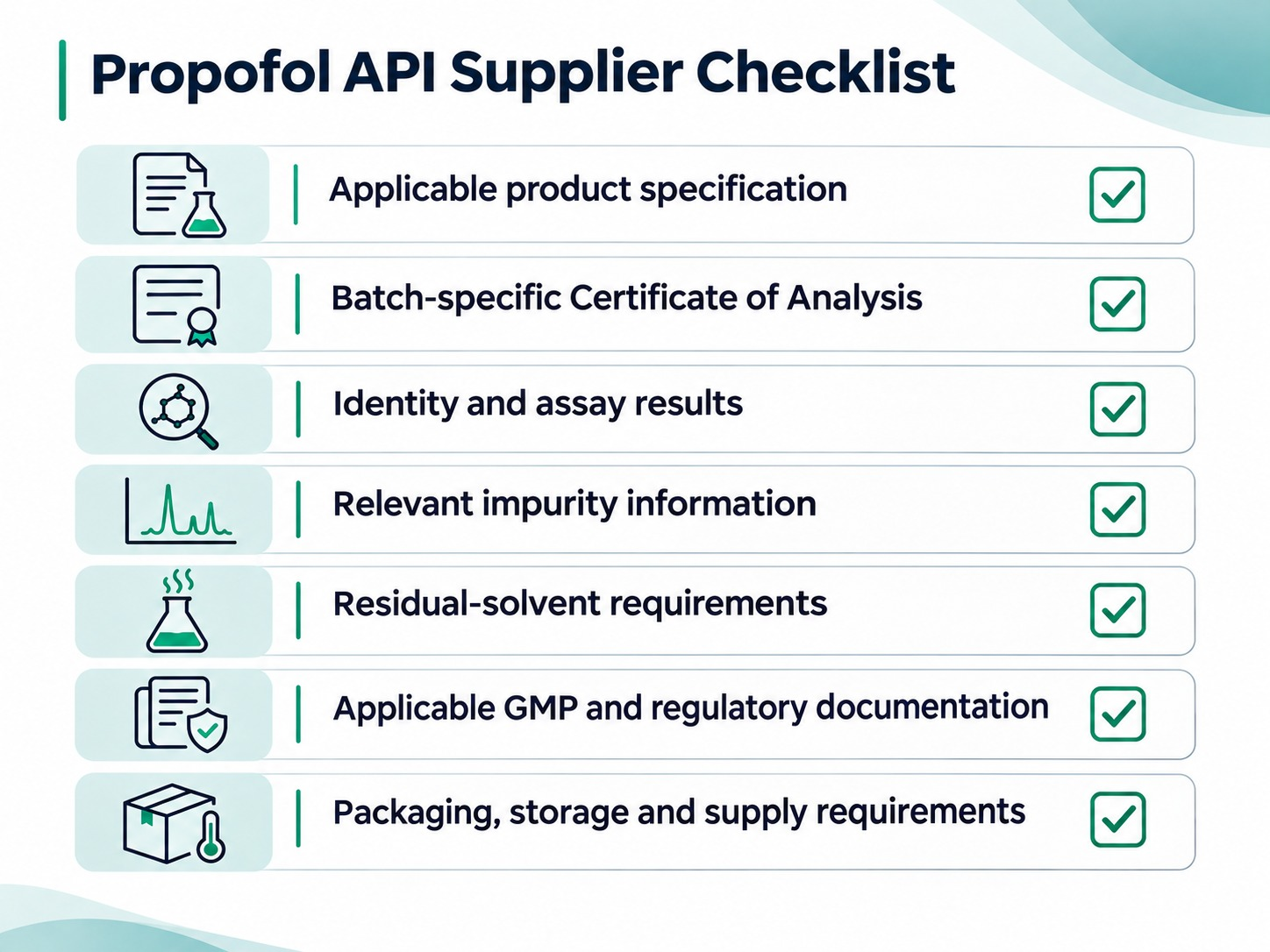
What Should Buyers Check When Sourcing Propofol API?
Before qualifying a supplier, procurement and quality teams can use these questions to guide their assessment.
1. Does the API meet the required specification?
Confirm the applicable pharmacopoeial standard, product specification and intended grade. Review the full specification rather than relying on a single purity figure.
2. Is a batch-specific Certificate of Analysis available?
Check the batch identification, tests performed, acceptance criteria and reported results. Ask for clarification if information is missing or requires further review.
3. How are impurities controlled?
Review the applicable impurity limits and ask for relevant product-specific evidence showing that the batch meets them.
4. Are relevant residual solvents addressed?
Confirm which solvents are relevant to the manufacturing process and whether suitable controls and testing are in place.
5. What quality and regulatory documents can the supplier provide?
Depending on the market, this may include applicable GMP documentation, technical information, stability data and other relevant regulatory records.
6. Are packaging and storage requirements clear?
Confirm that the packaging and storage conditions are appropriate for the API and supported by the supplier’s product information.
7. Can the supplier support consistent supply and communication?
Discuss availability, lead times, quality-related communication and how relevant changes or deviations are handled.
These checks help buyers make decisions based on product-specific evidence and the requirements of their intended market.
Propofol API at DK Pharma
DK Pharma lists Propofol API in its product portfolio and publishes information about its manufacturing and quality-control capabilities on its product page.
The company describes a controlled synthesis process, purification by vacuum distillation and batch-release testing that includes identity, assay, related substances and other quality attributes. These statements should be read alongside the current product specification and supporting documentation.
For prospective buyers, the next step is to confirm the requirements that apply to their intended market, including the available product specification, batch documentation, regulatory support and supply arrangements.
A supplier’s published information is a useful starting point, but product qualification should be based on the evidence available for the specific product and manufacturing site.
Frequently Asked Questions
What is Propofol API used for?
Propofol is the active ingredient used in injectable medicines for general anaesthesia and sedation. Pharmaceutical manufacturers use the API to produce finished formulations that meet applicable quality and regulatory requirements.
Why is impurity control important in Propofol manufacturing?
Impurity control helps demonstrate that the API meets its defined quality specifications. Suitable analytical testing is needed to assess relevant impurities against established limits.
Why should buyers check residual solvents?
Solvents may be used during synthesis or purification. Buyers should confirm that relevant residual-solvent requirements are addressed through appropriate process controls and testing.
What is the role of GMP in Propofol API manufacturing?
GMP provides a framework for controlling manufacturing, testing, documentation and quality management. It helps support consistent production and evidence-based quality decisions.
What documents should buyers request from a Propofol API supplier?
Depending on the intended market and supplier-qualification requirements, buyers may request the product specification, batch-specific Certificate of Analysis, relevant impurity and residual-solvent information, applicable GMP documentation and other required regulatory records.
Conclusion
Propofol API manufacturing requires more than achieving a target purity value. Controlled synthesis, suitable purification, impurity management, residual-solvent control, appropriate analytical testing and reliable documentation all contribute to demonstrating that the API meets its defined requirements.
For pharmaceutical manufacturers and procurement teams, the practical priority is to assess the supplier’s quality system alongside product-specific evidence.
A quality-first sourcing decision begins with clear specifications, reliable analytical results and documentation that supports the intended application and market.
Disclaimer: The information provided on this page is for general informational purposes only and does not constitute pharmaceutical, regulatory, technical or commercial advice. Requirements may vary based on the API, intended application and applicable regulations. Please contact DK Pharma directly for product-specific information and business enquiries. © 2026 DK Pharma. All rights reserved.

 By riya
October 27, 2026