Introduction
How can pharmaceutical companies assess whether an Active Pharmaceutical Ingredient (API) supplier can consistently meet their quality requirements?
The answer goes beyond the purity percentage mentioned in a product specification or Certificate of Analysis (CoA). Buyers also need to understand how the API is manufactured, how its quality is tested and whether the supporting records can be reviewed and verified.
This is where Good Manufacturing Practices (GMP), good laboratory practices and appropriate analytical testing become important.
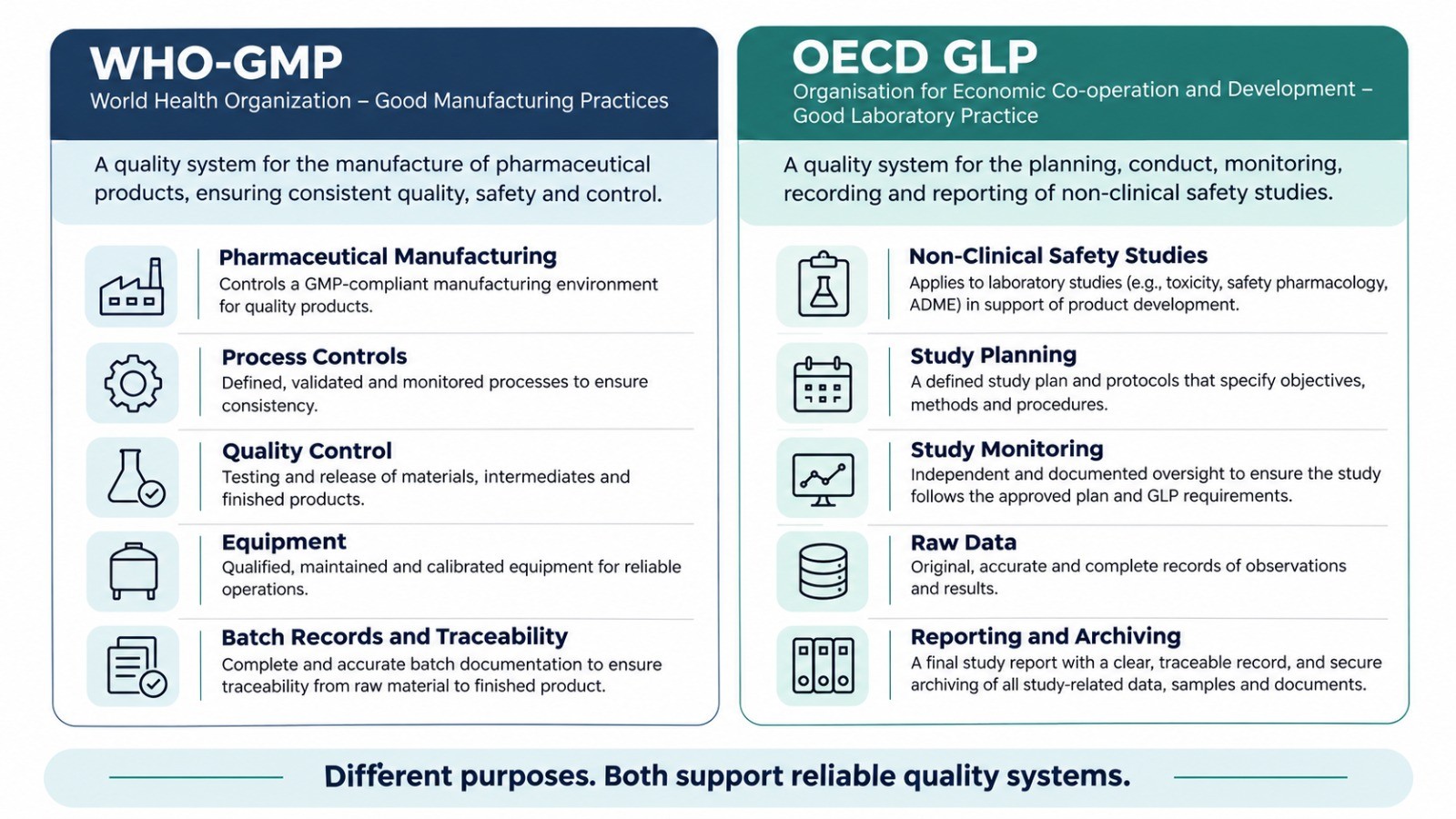
WHO-GMP provides a framework for controlling pharmaceutical manufacturing and quality. GLP, in its formal OECD context, applies primarily to non-clinical health and environmental safety studies. Although both support reliable scientific work, they serve different purposes.
For API buyers, understanding this distinction helps them ask better questions, review supplier documentation and make more informed sourcing decisions.

What Is WHO-GMP and Why Does It Matter for API Manufacturing?
Good Manufacturing Practices (GMP) are systems designed to ensure that pharmaceutical products are consistently manufactured and controlled according to appropriate quality standards. WHO-GMP guidance covers the processes, people, premises, equipment, materials and records involved in pharmaceutical production. Source: WHO — Good Manufacturing Practices
In API manufacturing, quality cannot be established by testing only the final batch. Manufacturing conditions and controls also matter because contamination, material mix-ups, uncontrolled process changes and inadequate records can affect the final product.
A sound GMP system typically addresses:
- • Raw material control: Materials are received, identified, assessed and approved according to defined procedures.
- • Process control: Manufacturing steps follow approved instructions and established controls.
- • Equipment and facilities: Equipment is suitable for its intended use, maintained and appropriately cleaned.
- • Quality control: Samples are tested against defined specifications using suitable methods.
- • Documentation and traceability: Records help establish what happened during manufacturing, testing and review.
- • Deviation management: Unexpected events are investigated and addressed through appropriate corrective and preventive actions.
For buyers, WHO-GMP status is an important starting point when evaluating an API manufacturer. However, they should also confirm the certificate’s validity, scope, issuing authority, covered site and relevance to the product and destination market.
What Is GLP in the Pharmaceutical Industry?
Good Laboratory Practice (GLP) describes principles for organising, conducting, monitoring, recording and reporting certain laboratory studies.
The term needs context. The formal OECD Principles of GLP primarily apply to non-clinical health and environmental safety studies, including studies used in regulatory assessments of chemicals. They cover areas such as study responsibilities, quality assurance, standard operating procedures, raw data and record archiving. Source: OECD — Good Laboratory Practice.
GLP should not be treated as another name for routine pharmaceutical quality-control testing or as a universal certification requirement for every API testing laboratory.
In API quality control, laboratories instead need appropriate controls for the specific testing they perform. These may include qualified equipment, suitable analytical procedures, trained personnel, documented methods, controlled records and appropriate review of results. WHO also publishes guidance specifically for pharmaceutical quality-control laboratories. Source: WHO — Good Practices for Pharmaceutical Quality Control Laboratories.
The key distinction: GMP controls how an API is manufactured and managed for quality, while formal OECD GLP governs how specified non-clinical safety studies are organised and reported. Laboratory quality-control practices support the testing of APIs but should not automatically be labelled OECD GLP.
WHO-GMP vs GLP: What Is the Difference?
| | |
| Consistent pharmaceutical manufacturing and quality control | Reliable non-clinical health and environmental safety studies |
| Production, process controls, testing, quality systems and records | Study planning, conduct, monitoring, reporting and archiving |
| API and pharmaceutical manufacturing | Relevant regulatory safety studies |
| Applicable GMP certification, site and scope, product quality records and supplier controls | Whether GLP applies to the specific study and whether relevant study records are available |
Neither term alone proves that a particular API is suitable for every application. Suitability depends on the product specification, intended use, applicable regulations and supporting evidence.
How Do Laboratory Equipment and Analytical Testing Support API Quality?
- A laboratory result is useful only when the method, equipment and testing process are appropriate for the intended purpose.
API quality testing may assess identity, assay or content, impurities, moisture and other product-specific attributes. The exact tests depend on the API, its specification, relevant pharmacopoeial requirements and applicable regulatory commitments.
Different instruments support different types of analysis:
● High-Performance Liquid Chromatography (HPLC): Commonly used to assess assay and impurities in suitable methods.
- ● Gas Chromatography (GC): Used for appropriate volatile compounds, including certain residual solvents.
- ● Infrared Spectroscopy (IR): Can support identification by examining characteristic absorption patterns.
- ● Ultraviolet-Visible Spectroscopy (UV): Used for suitable measurements involving ultraviolet or visible light absorption.
- ● Karl Fischer titration: Used to determine water content.
These instruments are not interchangeable, and no single instrument establishes every aspect of API quality. Testing must follow an appropriate, documented procedure.
Analytical method validation provides evidence that a method is suitable for its intended purpose. Depending on the method and application, validation characteristics may include specificity, accuracy, precision, linearity, range and detection or quantitation limits. ICH Q2(R2) provides guidance on analytical procedure validation for relevant pharmaceutical applications. Source: ICH Q2(R2), European Medicines Agency
For buyers, this means that a supplier’s laboratory capabilities should be assessed alongside the suitability of the methods, the specifications applied and the records supporting the reported results.
Why Validation, Stability Studies and Documentation Matter
For APIs, these controls help support quality decisions, investigations and regulatory documentation. Their scope should be appropriate to the product, process and intended market.
Buyers should also understand that stability data, validated methods and GMP compliance do not remove every supply risk. They form part of a wider quality system that includes change control, deviation investigation, batch traceability and supplier communication.
How DK Pharma Approaches API Quality Control
D.K. Pharmachem states that its quality management system includes in-house Analytical Method Validation (AMV), Process Validation (PV), stability and hold-time studies, supported by Quality Assurance oversight.
The company also lists HPLC, GC, IR, UV and Karl Fischer equipment within its Quality Control capabilities, along with WHO-GMP and ISO 9001:2015 certifications. Source: DK Pharma — Quality Management System
These capabilities are relevant to API buyers evaluating a manufacturer’s testing and quality systems. For a particular sourcing decision, buyers should still confirm the applicable certification scope, product-specific testing requirements and availability of relevant documentation directly with the supplier.
A supplier’s quality system should be evaluated on the evidence available for the product and site in question, not on a general claim alone.
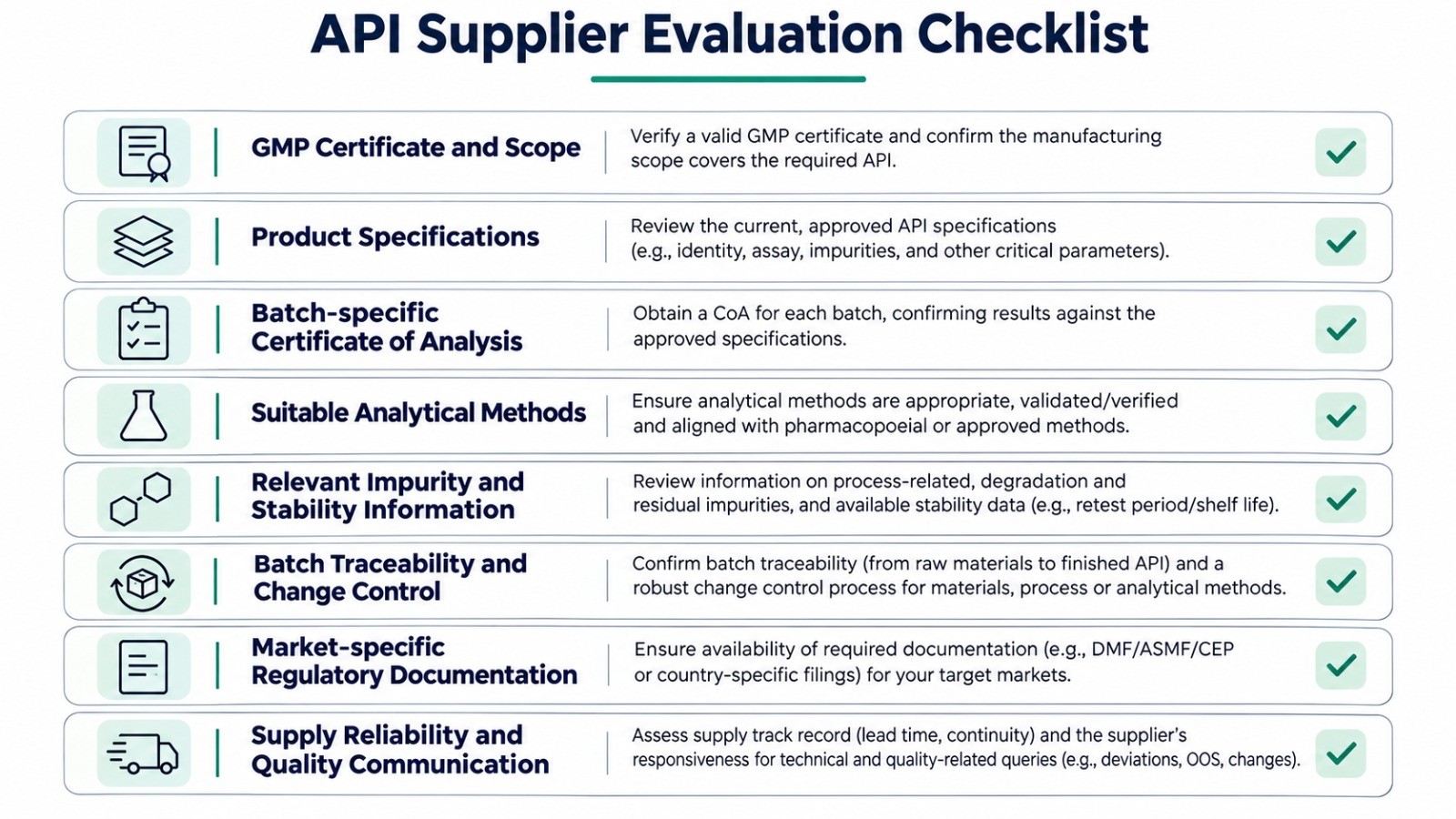
API Supplier Evaluation Checklist: What Should Buyers Verify?
Before approving an API supplier, procurement and quality teams can use the following checklist:
- 1. Certification and scope: Is the relevant GMP certificate current? Does it cover the manufacturing site and activities being assessed?
- 2. Product specifications: Are the API’s identity, assay, impurity limits and other relevant quality attributes clearly defined?
- 3. Certificate of Analysis: Does the CoA identify the batch, tests, specifications and reported results? Can the supplier clarify any result that needs review?
- 4. Analytical methods: Are the methods appropriate for the tests performed, with validation or verification evidence where applicable?
- 5. Impurity and stability information: Is relevant product-specific information available for the intended use and market?
- 6. Traceability and change control: Can the supplier explain how batches, deviations, investigations and relevant changes are documented?
- 7. Regulatory documentation: Can the supplier provide the documents required for the destination market and the buyer’s quality assessment?
- 8. Supply and communication: Are lead times, production availability, change notifications and quality-related communication handled through defined processes?
Not every document is required in every transaction. The precise requirements depend on the API, the buyer’s quality agreement, the intended application and the regulatory market.
Frequently Asked Questions
Does WHO-GMP certification guarantee API purity?
No. WHO-GMP supports controlled manufacturing and quality systems, but API purity must be assessed against the applicable specification using suitable analytical methods and batch-specific results. Certification should be reviewed alongside product-level evidence.
Is GLP mandatory for every API manufacturer?
No. Formal OECD GLP applies to specified non-clinical health and environmental safety studies. It should not be assumed to be a universal requirement for every API manufacturer or routine quality-control laboratory. Requirements depend on the activity and applicable regulations.
What is the difference between GMP and laboratory quality control?
GMP is a broader system covering manufacturing and quality management. Laboratory quality control is one part of that system, involving the testing and review used to assess whether materials or batches meet established requirements.
Why is analytical method validation important for APIs?
Validation provides documented evidence that an analytical method is suitable for its intended purpose. This supports more reliable interpretation of results for attributes such as assay, impurities and other specified quality characteristics.
What documents should an API buyer request from a supplier?
Depending on the product and transaction, buyers may request applicable GMP certification, product specifications, a batch-specific CoA, relevant analytical method information, stability data and market-specific regulatory documentation. Additional records may be needed during supplier qualification or quality audits.
Conclusion
WHO-GMP, appropriate laboratory practices, analytical testing, validation and documentation each play a different role in supporting API quality.
For buyers, the practical step is to look beyond a certificate or a single test result. Assess the manufacturer’s applicable quality systems, review product-specific evidence and confirm that the documentation meets the requirements of the intended market.
A well-informed supplier evaluation helps procurement, regulatory and quality teams make decisions based on documented evidence rather than assumptions.
Disclaimer: The information provided on this page is for general informational purposes only and does not constitute pharmaceutical, regulatory, technical or commercial advice. Requirements may vary based on the API, intended application and applicable regulations. Please contact DK Pharma directly for product-specific information and business enquiries. © 2026 DK Pharma. All rights reserved.

 By riya
October 26, 2026